Wheaton |
St. Charles |
Sycamore
 630-665-7300



- Home
- Our Firm
- Our Team
- George S. Frederick
- Lynn M. Mirabella
- Henry D. Kass
- Lindsay C. Stella
- Joshua D. Bedwell
- Stacey A. McCullough
- John W. Demling
- Megan C. Harris
- Kira N. Albrecht
- Jacqueline M. Mazur
- Bradley P. Erdman
- Catherine D. Sheehan
- Michael J. Rutcosky
- Jessica L. McGary
- Chad A. Baker
- Naseem N. Hosseini
- Lacey K. Boulware
- Lindsey G. Mirabella
- Amanda J. Werve
- Jordan E. Jenquin
- Matthew P. Karstens
- Maxwell J. Sharkey
- Joseph Mirabella
- John Kincaid
- Practice Areas
- Testimonials
- Media
- Blog
- Contact Us
Recent Blog Posts
Divorcing an Absent Spouse
 An issue occasionally encountered in divorce is that a spouse will simply walk out, disappear or otherwise not cooperate or participate in the divorce proceedings. Hence, this can lead to issues obtaining a divorce decree. If your spouse cannot be located or contacted, it can be a little more difficult to obtain your divorce. Consulting an experienced family law attorney is advised.
Divorce by Publication
Divorce by publication is the process during which you place your notice of divorce in the newspaper or other publications that serve the area where your spouse was last known to reside. Once the court grants permission, you may then place the notice in the relevant publication for a specific period of weeks.
Divorce by Default
If your notice has run for the prescribed length of time with no results, and you have exhausted other possibilities in attempting to locate your spouse you are able to ask the court for a divorce at that time, as your spouse is presumed to have defaulted on his or her right to contest the filing.
Post-Divorce Decree Modifications
 When two people divorce, they may arrive at an acceptable settlement to allocate their property and other interests, including parenting time with children and an amount of support. However, this does not close the book on all marriage-related matters forever. It is possible in Illinois to make certain modifications to your divorce decree after a Judgment is entered, though not all issues may be reopened.
Spousal & Child Support
In Illinois, a modification to either spousal support or child support may be made if a “substantial change in circumstances” has taken place. Modifications usually occur when someone has either sustained a loss (for example, if the noncustodial parent is loses a job), or when someone has had their financial situation improve. However, it is important to remember that until a court rules on a motion for a modification, payments must continue as previously set. If a party ceased paying support, or began to pay less, it could result in a party filing a petition seeking contempt of court.
Re-adoption in Illinois
 If you have adopted a foreign-born child, you may wish to go through a process called re-adoption after returning to Illinois. Though not required by law, re-adoption offers several benefits to both adoptive parents and the adopted child. Further, the process is usually a simple and happy occasion.
Reasons for Re-adopting
Perhaps the biggest reason for re-adopting is that the process ensures that any rights of the biological parents to the child are terminated. This will help protect against any potential issues, however rare they may be, that could arise in the future. Another benefit is that during the re-adoption process, the child's name can be legally changed. Frequently, adoptive parents desire to select their own name for their adopted child.
By re-adopting, documentation of the birth can be obtained simply by contacting the Illinois Vital Records. This is important because it avoids potential difficulty in obtaining the foreign adoption decree. Re-adoption allows for the creation of a Record of Foreign Birth, which is a legal and binding document that the adoptive parents receive upon the completion of the adoption. In order to acquire a Record of Foreign Birth, the adoptive parents must submit a Certified Illinois Certificate of Adoption and some other form of evidence of the child's date and place of birth, such as a certified copy of the original birth certificate.
Adoption and Birth Certificates
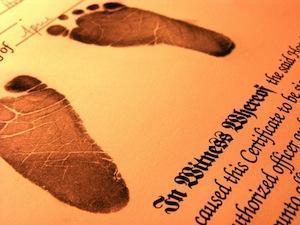 Adoption brings together a child in need of parents and individuals who are willing to meet that need. As a result, adoptions are very beneficial for both children and parents. However, due to the different nature of adoption, there are unique issues related to the child's birth certificate.
Requesting a Copy of a Birth Certificate
Under Illinois law, an adult adoptee (considered a person 21 years of age or older) can request a non-certified copy of his or her original birth certificate. Further, this law allows the biological parents of a child placed for adoption to specify whether they would like to be available in the event the child wishes to contact them. Biological parents can also make their identifying information available.
In order to request an original birth certificate, the individual must fill out a Request for a Non-Certified Copy of Original Birth Certificate. This form must be submitted with a copy of a valid government-issued photo ID and a check or money order for $15 to the Illinois Department of Public Health (Department).
Declaring a Marriage Invalid
 Under certain circumstances, an individual may wish to request that a court declare his or her marriage invalid. Invalidity of a marriage, which was formerly known as annulment, is a distinct process from divorce. In order to have a marriage declared invalid, the marriage must have occurred under specific circumstances as described by law.
Invalid Marriages
Under Illinois law, a marriage may be found invalid if it was entered into under one of the following conditions:
- One party did not have the ability to consent at the time of the marriage, which can occur because of a mental incapacity, or through the use of alcohol, drugs, or other substances, or because the party entered the marriage against his or her will (for example, because of the use of force);
- One party does not have the ability to engage in sexual intercourse due to a physical condition and, therefore, cannot consummate the marriage;
Illinois Family Law Changing
 In addition to child custody and visitation modifications, several significant changes to family law in Illinois will take effect January 1, 2016. These changes impact parents with children of all ages, as well as the process for obtaining a divorce.
Changes to Illinois Law
Beginning in January, under Illinois law, irreconcilable differences will be the only basis for divorce. As a result, it will no longer be necessary to argue and prove fault (such as mental cruelty, adultery and/or abandonment) to complete the divorce process. Also, if the parties have lived separate and apart for six months prior to the entry of the judgment to dissolve the marriage, there is a presumption that irreconcilable differences exist. Importantly, this presumption cannot be rebutted. The six-month period is a change from the previous two-year requirement.
After a divorce has been completed that involves children, custodial parents in Cook, DuPage, Kane, Lake, McHenry, and Will Counties will be allowed to relocate up to 25 miles from their current residence without court permission. Parents in all other counties will be allowed to move up to 50 miles from their current residence without the permission of the court. Additionally, parents can move up to 25 miles across state lines without court permission.
Child Custody: Splitting Siblings
 When a couple decides to get divorced, it can be particularly hard on any children involved. This is true even when a divorce is amicable and parents put the interests of their children first. Most times, children are kept together when it comes to child custody determinations. However, under certain circumstances, there may be reasons why it is desirable to have siblings split between the parents.
Splitting Siblings
Courts usually believe that it is in the best interests of children to keep siblings together and that the loss of living with one parent is already difficult enough. Therefore, the preservation of the sibling relationship is important. However, there are situations in which splitting up siblings may be acceptable and include the following scenarios:
- Siblings are not able to get along, to the point that they are abusive or combative towards each other;
Intercountry Adoption and Service Providers
 If you are interested in adopting a child from outside of the United States, it is important for you to be aware of the Hague Convention on the Protection of Children and Co-operation in Respect of Intercountry Adoption (Hague Convention). The Hague Convention made some significant changes to the requirements in international adoptions. While these changes increased the protections for those involved in adoptions, it also increased the time international adoptions take to complete. The following examines the requirements placed on adoption service providers under the Hague Convention.
Hague Adoption Convention
The Hague Convention is an international agreement intended to establish safeguards to ensure that intercountry adoptions occur in the best interest of the child being adopted and to prevent the abduction, sale, or trafficking of children. In the U.S., the Hague Convention became effective in 2008. The Hague Convention is applicable to all adoptions between the U.S. and other countries that have also adopted the Hague Convention. Most of the countries that individuals from the U.S. adopt children from are Hague Convention countries. A full list of the member nations of the Hague Convention can be found online.
Changes to Illinois Child Custody and Visitation
 On January 1, 2016, significant changes will go into effect in Illinois under the Illinois Marriage and Dissolution of Marriage Act (IMDMA). Specifically, changes will be made to child custody and visitation. Therefore, it is important to be aware of these changes as 2016 begins.
Allocation of Parental Responsibility
Beginning January 1, 2016, the entire section on custody will be named the Allocation of Parental Responsibility—the terms “custody” and “visitation” will no longer be used in Illinois. Moreover, custody orders, visitation agreements, and parenting agreements will be removed from the chapter and will be replaced with allocation judgments, parenting time, and parenting plans. An allocation judgment is a judgment that allocates or directs parental responsibilities.
Parental responsibility involves parenting time and significant decision making authority, with respect to the ordinary caretaking functions of minor children. Replacing the term visitation is parenting time, which is defined as the time a parent is responsible for conducting the defined care-taking functions and decision making responsibilities that are considered non-significant. Significant decision making responsibility is now considered a distinct category, separate from parenting time, and it involves issues that are of long-term importance to a minor child.
Antiques and Collectibles in Divorce
 Among the issues to resolve in some divorce cases is the division of antiques, collectibles, or other unique items. Although this type of property is commonly at issue in high net worth divorces, antiques and collectibles may be a part of any divorce. In addition to having significant monetary value, these items often have sentimental value. Because of this, it can make dividing this property very difficult, particularly in contentious divorces.
Dividing Antiques and Collectibles
Antiques, unique items, or collections such as art, coins, or wine, are often not easily dividable. Further, it can be difficult to determine the value of these types of items. Contributing to that difficulty is the fact that antiques and collectibles may have significantly increased in value since they were first purchased or acquired.
One certain way in which to deal with the division of this type of property is to sell all of it and then simply divide the proceeds. However, if there is an emotional attachment to the property, this will not be a desirable option. Instead, the property will have to be valued and allocated between the parties.
 Read More
Serving DuPage, Kane, Kendall, Will, Cook, and Lake Counties Since 1949
For guidance with your case, contact our attorneys at 630-665-7300. We will answer your questions, explain the process relevant to your case, and advise how best to proceed. Our firm has locations in Wheaton and St. Charles, Illinois, and we work with clients throughout the Chicagoland area, including, DuPage, Kane, Kendall and Will Counties.
Looking for something specific?
Search our site here.


From our law offices in Wheaton, St. Charles, and Sycamore, the family law and civil litigation law attorneys of Mirabella, Kincaid, Frederick & Mirabella, LLC represent businesses and individual clients throughout the western suburbs of Chicago, including Wheaton, Naperville, Oak Brook, Oakbrook Terrace, Glen Ellyn, Carol Stream, Lombard, Downers Grove, Burr Ridge, Hinsdale, Lisle, Elmhurst, Winfield, Woodridge, Warrenville, and throughout DuPage County. We also serve clients in Will County, Kendall County, DeKalb County, and Kane County, including St. Charles, Sugar Grove, Geneva, DeKalb, Batavia, Aurora, North Aurora, Elgin, Algonquin, Barrington Hills, Bartlett, Big Rock, Burlington, Campton Hills, Carpentersville, West Dundee, East Dundee, Elburn, Hampshire, Huntley, Kaneville, Maple Park, Sleepy Hollow, and Wayne.
Results listed are not a guarantee or indication of future case results.
1737 South Naperville Road, Suite 100, Wheaton, IL 60189
630-665-7300